Wednesday, January 29, 2020

Đức Phật thiện xảo phương tiện dạy về Không/Tính Không (bi-lingual)

                                                         * *


Trong Cula-suññatā sutta ( MN 121= Kinh Tiểu Không) , Đức Phật bảo Tôn giả ANan :
Pubbe c'āhaɱ Ānanda,
etarahi ca
suññatā-vihārena bahulaɱ viharāmi.
Cố HT Thích Minh Châu dịch:
“Thuở xưa và nay, này Ananda, Ta nhờ an trú không, nên nay an trú rất nhiều.”
Đó là câu dịch rất hay, nhờ chữ “an trú”. Nhưng cần làm rõ nghĩa vấn đề “an trú Không”
Nghĩa đen của câu trên là :
Ông Anan này, từ xưa , rồi nay ta đã sống trong nghĩa Không và thường sống trọn vẹn, đủ đầy với nghĩa Không .
Văn hoa mà vẫn chuẩn xác hơn có thể dịch :
Ông Anan này, từ xưa , rồi nay ta đã an trú trong Tính Không , và thường an trú nơi đó rất nhiều.
Điều cần chỉ ra là Đức Phật đã dùng chữ “Suññatā” (Tính Không= Voidness, Emptiness) để nói về sự an trú trong trong tư tưởng, thể nghiệm Không tính. Ngài đã không dùng chữ Suñña [“Không ( Void), Chân Không ( Vacuum)]. Điều này có nghĩa như thế nào ?
Điều này có nghĩa qua thiền quán , niệm tính và rút tinh yếu về Không, Chân không, Chân Tính của cái Không ( the true essence of the Void) muốn nói đến, Ngài đã sử dụng một phương pháp khác suy niệm, tư duy Tây phương; tuy cũng có những lúc tương tợ [tương tợ chút thôi] như phương pháp rút đặc tính, yếu tính của triết học Tây phương, từ thời Plato. Nói theo cách nói của triết học Tây phương từ Plato là lý niệm hóa , rút thể tính ( extracting essences) của sự , việc hay vật để diễn tả yếu tính, lý tính, hoặc thể tính của chúng. Xa xôi hơn nữa khoảng hơn 1000 năm sau nơi Tây phương thì gọi là khái niệm hóa. Lúc đó vấn đề khái niệm hoá, suy tư trên khái niệm, quanh vận chuyển khái quát hóa sự, vật đã đi quá xa , vì bắt đầu có quá nhiều sự và vật xuất hiện trong văn hóa con ngưòi; và thiền quán bên trời Tây ít có ai biết, nên thể tính, yếu tính sự, vật , nếu kinh nghiệm thực tế không được quán sát biết rõ, hay có khoa học thực nghiệm giảo chứng, sẽ kém thuyết phục. Tây phương dùng quan sát, lập giả thiết, tìm chứng cứ, rồi kết luận. Đó là khuynh hướng tìm đến bản chất, căn cốt của sự vật của những đầu óc minh trí, minh triết nhất , thường thấy trong các nhà tư tưởng có nhiều óc khoa học, ví dụ, Pythagoras, Thales, Archimedes, Democritus, và sau này Galileo, Copernicus. R. Descartes v.v. Còn trong triết học thì là suy niệm, khái niệm hóa sự việc rồi phân tích, suy tư. Tuy khác về phương pháp nhưng sản phẩm thành hình có khi cũng ít nhiều tương tự , qua con đường ngôn ngữ. Do đó, cũng có thể thấy, ngôn ngữ nhiều khi che khuất nhiều thứ và rát dễ gây ngộ nhận, nếu không sử dụng thiện xảo.
Điều thứ nhì muốn làm rõ là điều Đức Phật đã dùng Suññatā ( Tính Không= Voidness) trong kinh Cula-Suññatā sutta, trong Majjhima Nikaya ( Kinh Trung bộ) để giảng dạy tăng chúng về Không và Tính Không. Lập lại, Ngài đã không dùng chữ Suñña ( Không, Chân không) mà dùng chữ Suññatā ( Tính Không). Điều này xác lập rõ ràng, qua thiền quán, niệm tính là Ngài đã cố gắng giảng dạy trong kinh qua các thí dụ để “cái Không” xuất hiện để có thể “giảng”, “nói” như thế nào đó để yếu tính, thể tính của Cái Không hiển lộ. Nói theo kiểu triết học Tây phương Cái Không được tính niệm, lý niệm hóa thành Tính không. Phương tiện của Ngài thiện xảo, như có thể thấy, Không như “không có cái đó”, “cái đó đã được dời đi, biến mất”, cứ như thế mà niệm tưởng, quán sát, từ đó “ngộ” ra bản chất, yếu tính của Không- tức Không Tính (Suññatā)— trong tạng kinh Pali (Nam Phạn) của truyền thống Thượng tọa bộ ( Theravada tradition). Điều này hệ trọng , đứng trên mặt lịch sử và truyền thừa. Tức ta có thể tin rằng Tính Không (Suññatā) rất có thể đã được Đức Phật thuyết pháp, giảng dạy khi ngài còn tại thế; chứ không phải được thành lập sau này từ các đại sư vĩ đại trong Đại thừa ( Mahayana) như Long Thọ, Mã Minh , Vô Trước, Thế Thân v.v. Tuy rằng đóng góp của các đại sư, đại luận sư Đại thừa là rất lớn trong sự khai triển, phát minh rất vi diệu vể Tính Không.
Nếu chúng ta tin kinh điển Pali, xuất hiện từ thế kỷ 1 trước Tây lịch, truyền ghi lại đích xác y như những gì Phật dạy , thì chính Đức Thế tôn Cồ Đàm, chứ không phải các đại sư trong các phái của Thượng tọa bộ hay Đại chúng bộ đã truyền dạy về Tính Không.
Điều thứ ba, nó nói lên tầm quan trọng lớn lao của tư tưởng về Không, Tính Không trong Phật giáo, nên bậc Bạc- già-phạm mới thường xuyên “ở” trong đó, đi đứng nằm ngồi với Nó, và an trú trong đó.
Mấy hàng về ngôn ngữ :
  1. Nguồn gốc : Theo Thượng tọa bộ thì kinh Cula-Suññatā sutta được ghi nhớ , truyền tụng bằng miệng, rồi sau đó được viết xuống vào thế kỷ cuối trước Tây lịch. Tam tạng Pali đuợc bảo tồn, trao truyền và dịch ra các thứ tiếng trên thế giới ngày nay từ tiếng Tích lan. Mién điện, Thái lan, Cam bốt, Việt nam, Nhật , Hán, Anh, Pháp, Đức, Ý v.v. Như đã nói trên, Thượng tọa bộ luôn chủ trương và tin tưởng Tam tạng kinh của họ chính là những gì được ghi lại và xuất phát từ kim khẩu của Đức Phật. Vì vậy: chính Đức Thế tôn Cồ Đàm, chứ không phải các đại sư trong các phái của Thượng tọa bộ hay Đại chúng bộ đã truyền dạy về Tính Không. Chúng ta không có, không còn một bản Sanskrit (Bắc Phạn) về kinh này để đối chiếu. Chỉ có bản Kinh Tiểu Không trong bộ Trung A hàm do ngài Phật-đà Da-Xá, thầy của ngài Cưu Ma La thập, với sự cộng tác của thầy Trúc Phật Niệm, người Cam Túc dịch sang tiếng Hán. Thầy Tuệ Sỹ có một bản dịch trong link bên dưới. Bản dịch ba thầy, trong đó có một người Kế Tân ( Kashmir), một người Việt nam cách nhau khoảng 1600 năm đều hay. Riêng thầy Phật-đà Da-Xá ( tôi đoán là Thầy dịch từ tiếng Sanskrit) với cộng tác của TrPNiệm, dịch rất hay , chứng tỏ tiếng Hán của hai vị rất tuyệt. Thầy dịch như sau cho câu : “Thuở xưa và nay, này Ananda, Ta nhờ an trú không, nên nay an trú rất nhiều” thành
“Ngã tòng quá khứ dĩ lai, thường an trụ ư không quán chi trung”
thì thật là tuyệt, tuy có cắt ngắn đi một chút diễn tả ý “an trú rất nhiều” so với bản Pali. Dĩ nhiên, bản Sanskrit có thể không có đoạn sau xác định vềsự an trú rất nhiều
2. Từ vựng:
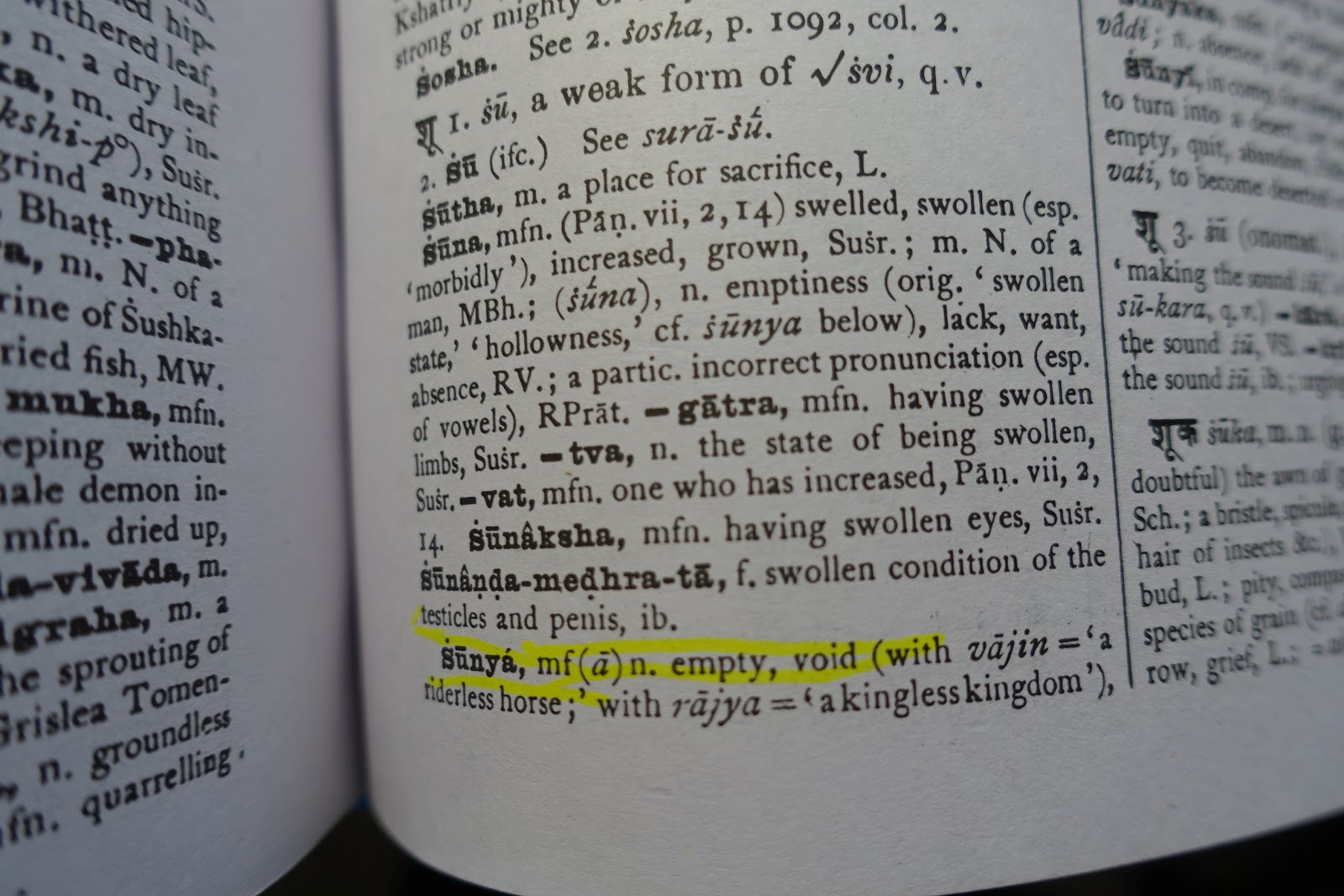
a ) Suññatā (Pali) có nguồn gốc từ chữ sunna (adj) , một tĩnh từ, hình dung từ; có nghĩa là rỗng không, trống rỗng ( empty, devoid). Tuy vậy, ở trong một trường hợp hiếm suñña được dùng đến thì có thể được dùng như một danh từ (noun) và mang nghĩa không gian, bầu trời hay khoảng không. Chữ tương đương bên tiếng Sanskrit là Śūnyà ( tự đìển Sanskrit-English của Monier-Williams), nhưng bên Sanskrit nói rõ hơn nhiều , đó là void ( cái rỗng không, trống không; vacuum ( chân không); hay một chỗ (place) không có gì hết.
Như vậy , nếu dùng theo nghĩa của chữ Sanskrit, thì Đức Phật đã có thể dùng chữ Śūnyà thì để chỉ đến một “Cái Không” trong đó không có gì hết, ví như ở trong những bong bong nước, ở trong bình chân không khi đả rút hết không khí ra. Tôi suy luận thì thấy Danh từ, xin nhắc lại “danh từ” Sankrit này có thể đã gợi ý cho Đức Phật để từ đó Ngài rút yếu tính để nói tới thể tính của cái Không là Śūnyatā (Tính Không) như một cách thái diễn dịch trong tư tưởng con người khi cần phải diễn tả, diễn đạt một điều trong căn nguyên vốn thuộc phạm trù trừu tượng. Trong vận dụng tư tưởng này, vào những lúc như thế Ngài với Socrates, Plato, Thales, hay Descartes, Kant, Husserl v.v. , cũng như chúng ta cũng đều trải qua những thể thức tương tự. Nếu chúng ta biết chữ Sankrit xuất hiện sớm hơn chữ Pali nhiều và thường được dùng như một thứ tiếng chuẩn xác, “thiêng liêng” trong văn học, kinh điển Phệ Đà ( the Vedas) và không ít nơi đã dùng chữ Sanskrit, dạng Devaganari để truyền tụng lời Phật dạy, thì khả năng để ý nghĩa chữ Śūnyà, gốc Sanskrit như Không, Chân không ảnh hưởng lên chữ được dùng cao hơn chữ Suñña tiếng Pali về mặt ngữ nghĩa để diễn tả điều muốn nói. Và kinh điển Pali ra đời sau khi Phật Niết bàn khoảng 500 năm.
b) Trở lại với Suññatā tiếng Pali. Suññatā được trừu tượng hóa, khái niệm hóa từ Suñña để chỉ điều trừu tượng về Không, Tính Không để nói lên đặc tính, yếu tính của nó. Và kinh điển Pali đã sử dụng ngôn ngữ theo cách này, vốn cũng là một đặc điểm chung của con người khi khái quát hóa một vấn đề. Nó được ghép chuyển từ một tĩnh từ sang danh từ và mang nghĩa triết học là voidness, emptiness, tức tính không.
3. Ý nghĩa :
a) Như đã nói ở trên, ý nghĩa về Không tính, như thế qua chữ nghĩa , ngữ nghĩa đã được minh định: rằng đó là thể tính rút ra qua ngôn ngữ “trừu tượng” để chỉ tới điều muốn nói là yếu tính “không thực sự có gì hết” ở trong tất cả sự, vật, tất cả đều là giả danh, duyên hợp.
b) Nói một cách chặt chẽ , cố HT Thích Minh Châu dịch chữ Suññatā là “Không” trong kinh Pali là có phần lỏng lẻo. Chuẩn xác hơn phải dịch là Tính Không. Tuy “yếu tính” và hình dạng, sắc chất của các vấn đề có khi cũng mang những điều giống nhau, ví dụ : thể hay tướng có thể là sóng , mà tính thì là nước. Nhưng qua cầu ngôn ngữ phải biện biệt rất kỹ để xem nội dung chúng giống hay khác. Nếu không phân biệt được thực thể các sự , vât và các biểu lộ, diễn đạt chúng qua ngôn ngữ thì có thể ngộ nhận.
----
English:
It is a very well-known fact that Meditative substance/thought in Śūnyatā( Voidness, Emptiness) was developed very thoroughly and profoundly by the Mahayanist exceptionally brilliant monks, such as Aśvaghosha (Mã Minh), Nagarjuna ( Long Thọ), Asaṅga (Vô Trước ), Vasubhandu (Thế Thân) and some others, especially the genius Nagarjuna with 3 of his treatises on the “philosophy/thought” on Voidness or Emptiness, in which the Mūlamadhyamaka kārikā or Fundamental Verses on the Middle Way is the stamp of this genius on Sunyavada.
But in this short article , I will prove that the Meditative substance/thought in Śūnyatā( Voidness, Emptiness) was much likely begun with the Buddha Gotama himself when he was alive.
In the Cula-suññatā sutta ( MN 121= Kinh Tiểu Không) in the Pali Canon , Buddha told Monk Ananda, his favorite monk, cousin and long time asistant :
Pubbe c'āhaɱ Ānanda,
etarahi ca
suññatā-vihārena bahulaɱ viharāmi.
in standard translation :
Formerly I, Ānanda,
as well as now,
have taken abode in Voidness,
thereof, I abide in the fullness
Pay attention to the Pali word “suññatā”. The noun means"Voidness” , or Emptiness. It is an abstract form from the adjective “ suñña”, In most of the cases, suñña, except in some , can be used as a noun to denote the space, the sky, atmosphere, similar to “ákasà”. A brother of this classical Pali language is the Sanskrit, which is the “sacred”language of the sacred Vedas of the Brahmins, and also the language that the Buddhist sutras were often recited, memorized , but not many of written records are extant. The monks in the Theravada tradition ( truyền thống Thượng tọa bộ) believe their Pali canon ( the Pali Tripitaka) recorded truthfully the teachings of Buddha from his own mouth and occasionally some disciples. Therefore, in this case we can trust that this sentence is the one uttered by the Buddha, the Bhagavan himself.
The Sanskrit equivalent for Suñña is “Śūnyà” (ref: Monier-Williams's Sanskrit-English), but the Sanskrit term is much more pronounced in denoting : void , empty space; vacuum; or a place with nothing at all. Thus, if having used in the sense of the Sanskrit word Śūnyà, the Buddha would be able to use the meaning of that word to refer to a Void in which nothing exist, such as that which inside water bubbles, the vacuum in a bottle when all the air has been removed. That is a possibility, because Buddha often taught in Sanskrit, too.
What needs to be pointed out is that the Buddha used the word "Suññatā" (Tính Không = Voidness, Emptiness) to talk about his well-abiding residency in thought, the experience of voidness . He did not use the word Suñña (Void, Vacuum). What does this mean? This means that through meditation, contemplation and extracting of essence to accommodate the sense of the void, and the truth of unsubstantiality (the true essence of the Void), he used a different method of meditation, different in nature to Western philosophical method of inquiry ; although there are similarities [just a bit and sometimes ] with the method of extracting the characteristics and essences of Western philosophy, from the Plato period, to conceptualize.But he arrived at some seemingly similar product—by name, through the way of language. Language, therefore, if not used carefully, rigorously, may deceive,
This clearly established— through meditation, contemplation— that he tried to teach in the sutta through examples so that the essence. , the nature of It is manifested. Speaking in the Western philosophical style, The Void (Cai Không) is conceptualized into emptiness.
The important point is , the term “Suññatā” ( Śūnyatā in Sanskrit) speaks of the great importance of the thought on voidness, emptiness in Buddhism, that’s why Buddha regularly "stayed" in it; walked, stood, lay down, and sat with It, and dwelled peacefully in It.
By the very meaning of the term “Suññatā” in Pali, its connotation and context in the sutta and in comparison with the Sanskrit “Śūnyatā” in the Prajna-paramita system, we can ascertain that the meaning, the essence of voidness had been taught by Buddha before any reciting , or writing session of the assembly of monks. These , then, again can be combined with the meaning, connotation in the Maha-Suññatā Sutta to have an even clearer proof.
Chân Huyền
Jan 28, 2020
---
REF


Thursday, December 12, 2019

Translation of “Sunyata” into “Voidness” in English


                            *

About 18 years ago, I was among the first two or three Buddhist practitioners to translate the Sanskrit terms “Sunya” ( Chân Không) and “Sunyata” (Tánh Không) into English as “Void” and “Voidness”. I know, now, most likely, the first one who had also translated Sunyata as Voidness in 1997, is Dr. Harischandra Kaviratna, a Sri Lankan scholar. (1) It is a pleasure to see someone in the Theravada tradition come to the same rendering to mine. At least etymologically. I have checked translations on the Internet in Buddhist literature of very well-known scholars from Sir Monier-Williams (Sanskritist, professor, lexicongrapher), Max Muller (Sanskritist, professor, lexicongrapher), Edward Conze (Sanskritist, scholar, author); T R Murti ( Philosophy professor, Madhyamika scholar), Theodore Stcherbatsky ( Buddhist scholar), R. H. Robinson ( scholar), David Kalupahana ( scholar, author) Naniswar (Bengali author, teacher) to later lesser-known  researchers like Bhikkhu Analayo,  Thanissaro Bhikkhu, Bhikkhu Bohdi , Jay Garfield, and 
others in Mahayana, or Hinayana schools. They have
also joined in to translate it as emptiness.

Only recently, “Void” and Voidness have gained ground, traction within last 5-8 years or so (2)

Cf:  Article in Wikipedia with link below on “Sunyata”, Encyclopaedia Britannica  (3)


“Void”, as a noun, to translate, and write about “Sunya” can be seen here and there, to denote something empty, voided of any substance, component, since it is easy to describe such an unsubstantial entity, being in The Essentials of Buddhist Philosophy(4) by Junjiro Takakusu. He did use the term “void” to mention the “sunyata” characteristic.

From the beginning and then after 20 years of studying and practicing Buddhism by 1999, I always felt that the term, the word “Emptiness” { this was used, adopted very much , I believe , due to the influence of the Buddhist scholar Edward Conze, and maybe to a much lesser degree , the Sanskritist Monier-Williams. Ed Conze was an outstanding, splendid scholar; his works on the Large Heart Sutra, on the Diamond Sutra have proven indispensable for at least 3 generations in the West from the latter of 1950s. Conze’s translations of Sanskrit texts have been much appreciated} does not really reveal, show the true essence, the true nature of Sunyata. Here are the whys:

1.   I believe and think: linguistically, it is too mechanistically applied/translated for the sake of finding an equivalence in another language. “Emptiness” is easily an earliest and very strong  “candidate” for translation, especially for the sense, the feeling it provokes in readers. Also in meaning and connotation it does the job well enough to signify, to denote something empty; some space, some feeling; some philosophical concept, some place, some region being taken away with their properties, or existential components.

2.   “Emptiness” always/often gives the sense of disappearance, loss of things that were previously there. As such , it is very “ontical” in its definition, very “physical”, “body-wise”, shape, form defined. Even when the things are gone, the feeling, perception for the loss is very “real”, very ontically-related and structured.

3.   In the mean time, “Voidness” , from its own essence, nature—from the beginning— there is Nothing in it, yes, there is Nothing, I repeat— from the very beginning. And it is ontologically-oriented [ philosophically in the Western philosophical sense]; its essence/nature shows us so, if we meditate, contemplate long enough. Speaking about it philosophically, it is the abstract extract from the real fact of “forming-disforming”

4.   The difference between Emptiness and Voidness is : Emptiness indicates the removal, disapearance of things, originally there in that "space", while Voidness, from the very beginning is “contained” in the very essence of things when they lose their binding components, when they disintegrate.

5. In a more sublime, sophisticated way, Emptiness does not carry what Voidness does, namely to deny the truth of the existence of any inherent characteristics, or features of all things, entities as having selves by their own— this human SElf included. The words Void and Voidness suggest “voidification”, suggest a void-out of any substantiating core, or self-built nucleus existing on its own charateristic , or quality. Logically they suggest the negation that any thing, any event, any fact as having any essence by its own, as not having composites.

Some explations/explications :

a)   Void can be seen readily in these examples:
-       Water vaporizes
-       Foods, fruits decompose
-       Chemicals disintegrate
-       Feelings subside and disappear
                 When things disintegrate, void will be more easily  
                 observed; the components, ingredients, elements,
                 attributes etc. subside, disappear

b)  That fact, that experience as we see, feel it can
    happen in a few minutes, a few seconds, an hour,
    or a whole day; a month, or even 10, 20 , 30  years.
   The process is  there and continuously moving,
    changing in all  those times. Therefore, it is said
    in the sastras ( discourses), Void is inherent in
    all things.

c)   In abstraction, Voidness is mentally formed for the sake of explaining in philosophical sense,  after long years of meditation on this essential feature of the forming and disappearing of all things. That’s what has been taught in the Prajna-paramita sutras ( long and fort forms), and enticed Nagarjuna Bodhisattva into writing “Madhyamika Karika”

d)  Therefore, philosophically Vois is abstracted,
“conceptualized” into Voidness for the sake of discussion.

e)   As an innate feature, property, from the very beginning of any forming of anything, physically or mentally, void /voidness is there. That’s the reason I chose to use “Voidness” and “Void” to translate “Sunyata” and “Sunya”. Because of this “beginning-ness”. The whole process will show the same feature. It is just hidden and at times intricate to observe, see.


Even though, it’s just one word, one term—
 “Voidness” for “Sunyata” – I am very glad I have translated into English, my second language, as such to contribute to the English speaking world that term, together with about a dozen of articles I wrote to explain, elucidate this essence, this essential characteristic and meaning of this most magnificent, profound representation of the experience in meditation and contemplation of Sunyata.


Notes :

* New finding by Jan. 2020: The first one to render Suññata (in Pali) { edited, revised by Bhikkhu Bodhi in 1995 } into to English as "Voidness" is Ñanamoli Thera, a monk and rather well-known translator, teacher of dharma, not Dr. Harischandra Kaviratna from Sanskrit.
http://obo.genaud.net/dhamma-vinaya/wp/mn/mn.121.ntbb.wp.htm


1. Before 1997, then around 2001, there was no third one, (as I attempted to survey), who translated “Sunyata” as “Voidness” among the well-known authors, scholars, and also the lesser-known ones —as the Internet shows.


4. Takakusu, Junjiro. The Essentials of Buddhist Philosophy. Univ. of Hawaii, Honolulu, 1947.

5. Max Muller and T. Stcherbatsky did not translate it, but leave it as “Sunyata”


6. Below, among many, some websites with translation Sunyata as Emptiness, as a continuous  trend in rendering the term as such where choice, meaning, “philosophical significance” have been considered somehow. Also in books, for example, The Logic of Unity: The Discovery of Zero and Emptiness in Prajnaparamita Thought, 1987, by H. Matsuo and K. Inada (trans.)


7. Evidence for who care to inquire  when I translated/used the term “Voidness” for “Sunyata” and “Void” for “Sunya” can be seen on my translation of Most Venerable Thich Tuệ Sỹ’s  book on Sunyavada : Triết Học về Tánh Không, 1970 and convesation messages on VN-buddhism in yahoo group, as pictured and given below


  7a) Translation by me of the first part of “The Philosophy of Voidness” was started in 2001 and sent to Ven. Thich Tuệ Sỹ. The complete introduction was done in 2008 , and the whole introduction  posted on my blogspot in Dec. 2014. So by 2001, I had translated the term Sunyata to Voidness.

  7b) The cause to get the book wholy translated did not get the stimulating element to grow to a full fruition . But it was a nice experience to me to work on it.

 7c) In yahoo group VN-Buddhism , under nickname eludy2001 ( TN= Tâm Nguyên) , I  commented in July 2004 on an article about an itchy monk


8. Translations of Sunyata into “openness”, “spaceness” in some recent books, or articles reflect a very silly translation, repugnant non-understanding of this beautiful, mesmerizing Essence/Nature

9. The Hrdaya Prajnaparamita Sutra ( Heart Sutra) translated from Sanskrit to English by Dr. Harischandra Kaviratna


Tâm Nguyên (CH)
December 2019

-----


Below: from “The Conception of Buddhist Nirvana” by Theodore Stcherbatsky


Sunday, December 8, 2019

Therefore, O Sariputra, in Voidness there is no bodily-form, no feeling...(trilingual)

..., no mental imaging, no consciousness; no eye, ear, nose, tongue, body, or mind...


                                                              * *


The most difficult part, like hitting your head at a stone wall, to break through and grasp understanding of the core teaching in the Heart Sutra ( Hrdaya Prajnaparamita Sutra), I believe, is this :

There is no form (rupa), no feeling(vedana) , nor perception (samjna) , nor impulse (samskara) , nor consioucness (vijnana)

To perceive, “absorb” this Real-i-ty[ the REAL of this entity], to touch it, taste it; and truly “understand” as one understand a feeling, an emotion, a perception [ physically, or mentally] requires a lot of meditative practice , i.e. vipassana meditation on the body, feeling, consciousness and things ( dharmas) as well deep contemplation on them. Not as concepts, thoughts, thought experiments, theories in a theoretical, philosophical way whereby the major source of searching, investigating, thinking is the sixth sense ( the manovijñāna) when one learns a new subject; logic, chemistry, grammar, biology, or does mathematics, physics, or writes essays, compositions.

To be sure, analytical, meditative-contemplative thoughts can help later in the process of REALizing the truths about these five No’s; but first of all one has to realize them by perceving, “seeing” how they appear, form, stay a while , then disappear in one’s mind-body complex, or the Consciousness of of one’s mind-and-body. That means, one has to practice meditation. Meditation on the Breath, on feelings of body, of emotion and of things— mentally, conceptually and their related components.

Inquiring the way Western philosophy reserchers, philosophers use, direct their methods: research, compare, correlate, hypothesize, analyze and conclude do not help much. That’s why L. Wittgenstein emphasized the the importance of the act of “Observe” { “Don’t think, but observe}, and to some extent, E. Husserl also recommended persistent observation before forming any theory, rationalization.

Back to our “Five No’s”:

It maybe easier to realize the later four No’s. But it is extremely hard to “SEE” the truth of the First one: No Form, meaning , the No of the bodily “I”, this I , this Self of all kinds of feelings, emotions and all the “crabs” intermingling, interacting, interfacing, interbeing, inter-absorbing in It.

How can we deny, refute the existence of this Self— this body with the other aggregates, especially thus physical body ? It’s there; we see , feel, touch, smell it every momentt of the day. It’s constantly there, continuously there, repeatedly everyday— it’s in the mirror, it hears music, birds sing, it smells cơm khê ( half-burned rice); it eats, it takes showers, brushes teeth; it works,  studies, plays in the garden, types these words— how and we refute its existence, or deny It ? Must be crazy, or delusional, or schizophrenia-influenced to say that (1).

Yes, with all those belonging-acts, functions, those attributes, features, characteristics, it seems only the wackoes, the lunatics may deny It, but in fact, it is a MOST PROFOUND, INCREDIBLE, PENETRATING, BARRIER-IMPLODING-DESTROYING Discovery in Truth for the Selves for all of us. Started by the Buddha Gotama, from the Khastrya clan of old India.

Studies, researches, thinking, analyzation, leaning from the sutras and sastras, contemplation etc. in the West philosophical way as said earlier, in 5-7 years, can only understand a little, or somewhat the “skin” part of it, as often repeated in Zen literature. To go further requires continuous learning, practicing meditation and diving deep into the mind-body complex to cultivate the bhàvana to gradually peel off thousands of “incorrect”, naive, or depthless layers of  perception, thinking, framing, realizing, and conception to discover this about the Voidness of this body, of the Self.


Note :

1.   This is also warned, talked of in the Heart Sutra


Chân Huyền
12/2019


----


Tiếng Việt
Phần khó khăn nhất, như đập đầu vào đá, trong Tâm Kinh Bát Nhã là ở câu này :
“Thị cố không trung , vô Sắc, Thọ Tưởng , Hành Thức”
Để có thể thực sự Hiểu, Thâm nhập vào nó, thâm nhập vào Thực tính của nó; để chạm vào nó, nếm nó; và thực sự là người hiểu nó như ta hiểu một cảm giác, một cảm xúc, một nhận thức [về vật chất hoặc tinh thần] đòi hỏi rất nhiều thực hành thiền định, tức là thiền vipassana trên cơ thể, cảm giác, ý thức và các pháp (dharmas) cũng như chiêm nghiệm sâu sắc về chúng . Không phải như với khái niệm, suy nghĩ, thí nghiệm tư tưởng, lý thuyết theo cách tìm hiểu trong lý thuyết, triết học, theo đó nguồn tìm kiếm, điều tra, tư duy chính là giác quan thứ sáu (manovijñāna) khi người ta học một môn học mới, thí dụ: logic, hóa học, ngữ pháp, sinh học, hoặc khi làm toán học, vật lý, hoặc viết tiểu luận, sáng tác.C
Chắc chắn là những suy nghĩ phân tích, suy ngẫm có thể giúp vào-- sau này-- trong quá trình Nhận chân được những sự thật về năm cái Không này; nhưng trước hết người ta phải nhận ra chúng bằng cách nhận thức được chúng, “thấy” được cách thức chúng xuất hiện, hình thành, tồn tại một lúc, sau đó biến mất trong thân- tâm, hay Tâm thức . Có nghĩa là, người ta phải thực hành thiền định. Thiền về hơi thở, cảm giác về cơ thể, cảm xúc và những thứ khác— trong tư tưởng, khái niệm và thứ liên quan.
Suy tư theo cách các triết gia phương Tây tư duy qua khái niệm để khảo sát, so sánh, phân tích , lập giả thuyết v.v. không giúp gì được nhiều. Quan sát, quán sát là quan trọng.
Làm thếnào chúng ta có thể phủ nhận, bác bỏ sự tồn tại của Bản thân này— với ngũ uẩn như sờ sờ ra đó, đặc biệt là cơ thể vật lý này? Nó ở đó; chúng ta thấy nó , cảm nhận, chạm vào nó, ngửi nó mọi khoảnh khắc trong ngày. Nó liên tục hiện diện, liên tục ở đây , ở đó, lặp đi lặp lại hàng ngày. Nó trong gương, nó nghe nhạc, chim hót; nó ngửi thấy mùi cơm khê; nó ăn, tắm, đánh răng; nó hoạt động, nghiên cứu; chơi trong vườn, gõ những từ này; làm sao chúng ta có thể bác bỏ sự tồn tại của nó, hay phủ nhận nó? Phải là kẻ điên rồ, hoặc ảo tưởng, hoặc bị tâm thần phân liệt để phát biểu như thế. Thế nhưng điều này cũng đã được Tâm Kinh Bát Nhã căn dặn : Bồ đề tát đỏa y BNBLMĐa cố , tâm vô quái ngại,vô quái ngại cố, vô hữu khủng bố...Hãy tin tưởng , đừng sợ hãi, dù mới nghe hay “nghe” nhiều lần rồi mà chưa thấu lý , thì cũng đừng sợ , hãy học hỏi, nghiên cứu, hành tập thêm.
Với những đặc điểm, tính chất , cơ năng như vậy, thì thường chỉ những kẻ điên rồ mới chối bỏ một cái Sắc, cái Thân như thế, phải chăng ? Tuy nhiên, Thấy được và từ chối nhìn nhận Sắc, Thân này ( cũng như Thọ , Tưởng, Hành , Thức) là một Khám phá TUYỆT DIỆU, KHÓ TƯỞNG, THÔNG THẤU SUỐT Nhất về một Sự Thật cho tất cà các cái ngã của chúng ta. Đìều đã được Đức Phật Cồ Đàm, từ dòng Sát đế lợi Ấn độ cũ khởi đi.
Học hỏi kinh luận, nghiên cứu, suy nghĩ, phân tích, trầm tư trong cách thái truy lùng kiểu triết lý phương Tậy trong 5-7 năm đầu chỉ có thể thâm nhâp vào đạo pháp phần nhỏ nào. Để tiến xa hơn cần phải tiếp tục học hỏi , tập thiền, và đào sâu vào cơ cấu Thân-Tâm để luyện tập, trau dồi Giải thoát tri kiến để dần bóc hết các mê lầm nhân thức, tri giác, các ảo kiến ( thường được gọi là kiên cố vọng tưởng) về Sắc thân để Thấy được, Khám phá được Sắc thân này Ngã này “đầy tinh thể” Tánh Không.
----
Spanish
La parte más difícil, como golpear tu cabeza contra una pared de piedra, para romper y comprender la enseñanza central en el Sutra Del Corazón ( Hrdaya Prajnaparamita Sutra), creo, es esto :
No hay forma (rupa), no hay sentimiento (vedana), ni percepción (samjna) , ni impulso (samskara) , ni consioucness (vijnana)
Para percibir, "absorber" esta Realidad [ el REAL de esta entidad], para tocarlo, probarlo; y realmente "entender" como uno entiende un sentimiento, una emoción, una percepción [ físicamente o mentalmente] requiere una gran cantidad de práctica meditativa, es decir, la meditación vipassana sobre el cuerpo, el sentimiento, la conciencia y las cosas (dharmas) así como la contemplación profunda en ellos. No como conceptos, pensamientos, experimentos de pensamiento, teorías de una manera teórica, filosófica, mediante la que la principal fuente de búsqueda, investigación, pensamiento es el sexto sentido (la manovijñána) cuando uno aprende un nuevo tema; lógica, química, gramática, biología, o hace matemáticas, física, o escribe ensayos, composiciones.
Sin duda, los pensamientos analíticos y meditativos-contemplativos pueden ayudar más adelante en el proceso de darse cuenta de la verdad acerca de estos cinco No; pero primero uno tiene que darse cuenta al percibir, "ver" cómo aparecen, formar, quedarse un tiempo, luego desaparecer en el complejo mente-cuerpo, o la conciencia de la mente y el cuerpo. Eso significa que uno tiene que practicar la meditación. Meditación sobre el Aliento, sobre sentimientos de cuerpo, de emoción y de cosas, mental, conceptualmente y sus componentes relacionados.
Inquidiendo la forma en que los investigadores de filosofía occidental, los filósofos utilizan, dirigen sus métodos: investigación, comparación, correlación, hipótesis, analizar y concluir no ayudan mucho. Es por eso que L. Wittgenstein enfatizó la importancia del acto de "Observar" { "No pienses, pero observes”}, y en cierta medida, E. Husserl también recomendó la observación persistente antes de formar cualquier teoría, la racionalización.
Volver a nuestro "Cinco No":
Tal vez sea más fácil darse cuenta de los cuatro No posteriores. Pero es extremadamente difícil "VER" la verdad de la Primera: Sin Forma, significado, el No del "yo" corporal, este Yo, este Ser de todo tipo de sentimientos, emociones y todos los "cangrejos" entremezclando, interactuando, inter-siendo , interabsorbiendo en Él.
¿Cómo podemos negar, refutar la existencia de este Ser, este cuerpo con los otros agregados, especialmente este cuerpo físico? Está ahí; Lo vemos, sentimos, tocamos, olemos en cada momento del día. Está constantemente allí, continuamente allí, repetidamente todos los días, está en el espejo , oye música, pájaros cantan; huele a cơm khê (arroz medio quemado); come, toma duchas, cepilla los dientes; trabaja, estudia, juega en el jardín, escribe estas palabras, ¿cómo podemos refutar su existencia, o negarla? Debe estar loco, o delirante, o influenciado por la esquizofrenia para decir que (1).
Sí, con todos esos actos de pertenencia, funciones, esos atributos, características, características, parece que sólo los locos, los lunáticos pueden negarlo, pero de hecho, ese es el descubrimiento extremadamente profundo, INCREÍBLE, PENETRANTE. Es el instrumento para DESTRUIR las barreras para descubrir la verdad para el Ser para todos nosotros. Iniciado por el Buda Gotama, del clan Khastrya de la antigua India.
Los estudios, las investigaciones, el pensamiento, el análisis, aprendizaje de los sutras y satras, la contemplación, etc. en la forma filosófica de Occidente, como se dijo anteriormente, en 5-7 años, solo pueden entender un poco, o algo así como la parte de la "piel", como a menudo repetido en la literatura Zen. Para ir más allá, se requiere un aprendizaje continuo, la práctica de la meditación y sumergirse profundamente en el complejo mente-cuerpo para cultivar la bhàvana para pelar gradualmente miles de capas "incorrectas", ingenuas o sin profundidad de percepción, pensamiento, encuadre, realización y concepción para descubrir esto sobre el Vacío de este cuerpo, del Ser.
Chân Huyền
Dec. 2019
===
Nota:
1. Esto también se advierte, se habla en el Sutra del Corazón

Chân Huyền
12/2019


* In one month, or  there will be a response on how it is so, for the ones who meditate, ponder, contemplate and want to learn


Tuesday, December 3, 2019

Flash


Your falls

   flash

      moments

        of Impermanence